

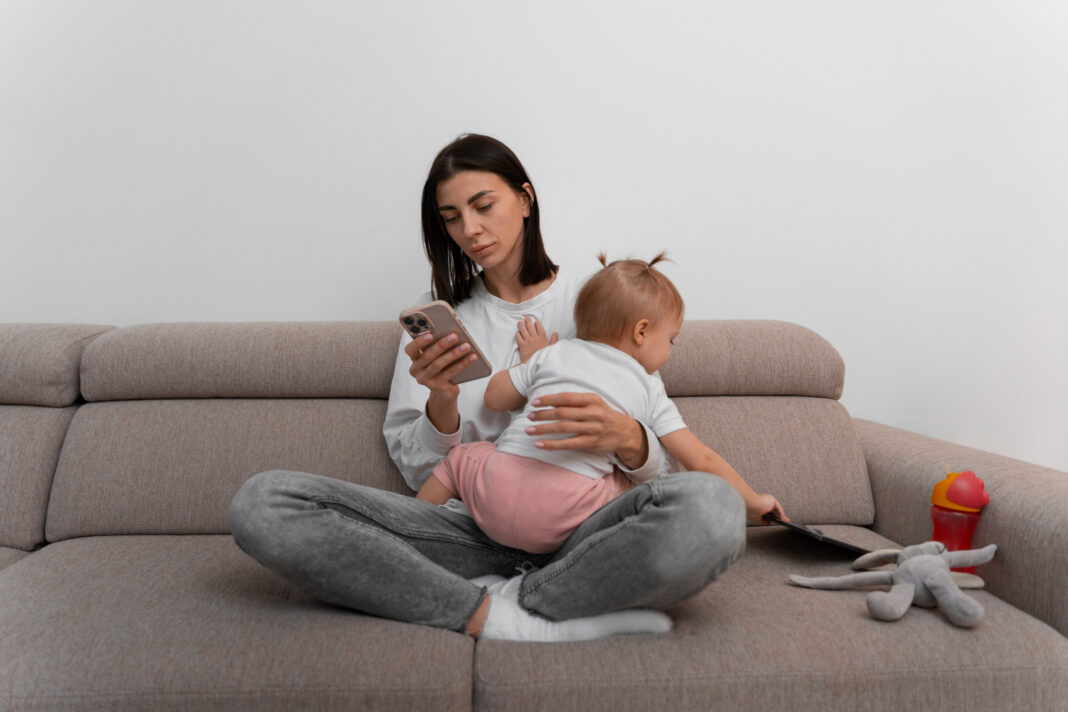

Many of us are struggling—like Jennifer Lawrence’s character in Die My Love—with the monotony of daily life. And scrolling is our coping device.
Last weekend, my son was putting on his socks and shoes so I could take him to a birthday party when he overheard my husband tell my daughter they’d be going to the mall. Instantly, he launched into one of the most common parental battlegrounds called: “That’s not fair!”
In an attempt to smooth things over, my husband told my son he’d save him some cinnamon pretzels so he wouldn’t totally miss out. Of course, my son shot back, “But they won’t be warm!”
That’s when I lost it.
I didn’t yell, that’s never been my style, but I crouched down, dropped my voice an octave and informed my son that he had no business telling his parents cold pretzels “weren’t fair.” I told him that if I had a choice about how to spend my day, it would absolutely not involve sports birthday parties for 7-year-olds or mall runs. But I don’t complain about not having choices right now, because this is the season we’re in.
My son stared at me wide-eyed, whispered “oh,” and quietly headed to the car.
And as the car door shut, I felt that familiar tug, the reminder that this is the deal I signed up for. I knew that once I had children, my freedom would shrink. Logistics would slow me down. Time would no longer fully belong to me. That was a sacrifice I felt comfortable with going into the role.
But then, the banalities of parenthood caught up to me. Pre-parenthood, I had no way of knowing just how trapped you can feel with kids you thoroughly wanted and vehemently love.
I was surprised by the quiet misery that fills the small gaps in a parent’s day, those 10-15 minute stretches that are too short to do anything but long enough to feel like eternity. Without a meditative mindset (or a hobby that can be done one-handed while holding a baby), I turned to my phone.
Stuck under a napping infant? Scroll social media.
Waiting for your child to tie their shoes? Check your feed and find your zen.
Sitting in the hallway, making sure your toddler stays in their new “big kid” bed? Cue the endless thumb-flick through updates and reels.
Eventually, the habit snuck into other corners of my life, and I know I’m not alone. Many parents are in the same boat, reflexively scrolling between diaper changes and soccer practices.
But here’s the problem: scrolling feels just as empty as the moments I’m trying to fill. It doesn’t add value, and it quietly pulls you out of the small, ordinary moments that matter, leaving you mentally checked out while your kids are right there, sensing you aren’t fully present.
While reports often focus on teenagers needing a digital detox, I’m quite sure many of us adults who have accidentally fallen into a scrolling habit are craving one too. According to “The New Normal” by Common Sense Media, 52% of parents say they spend too much time on their mobile devices. Additionally, a 2023 survey from Qustodio found that 48% of parents say they struggle to manage their own screen time.
I’m not surprised at the data. But, if adults can’t manage the brain drain, how can we ever expect our kids to?
This thought hit me hard.
Harder yet was a report on how parental scrolling can have a deeper impact than we imagine. A systematic review in JAMA Pediatrics found that when parents use digital devices around their children, what researchers call “technoference,” it’s linked to weaker attachment, higher child anxiety, and more behavioral challenges. In other words, we are losing our connection to our children when we get lost in our phones.
Most advice about breaking this cycle boils down to some version of a digital detox. But that can feel isolating or unrealistic. When I deleted my social media apps last year, I found myself feeling disconnected from other parents. The truth is, these platforms do offer busy parents a sense of connection to their community that is difficult to replicate elsewhere.
Instead, I made a plan to try a few simple, sustainable habits. Here’s how each one of them went:
Recommended tip: “Move your phone to charge in another room.” Effectiveness Rating: 8/10
I thought this would revolutionize my mornings. Spoiler: it didn’t. I still get up and retrieve my phone pretty soon after waking.
But my nights? Completely different. Without my phone by the bed, I actually read. I don’t end the day in a haze of doomscrolling and mental to-do lists. I don’t wake up at various points in the evening to the buzz of an email alert or late-night text either. It’s genuinely peaceful.
Recommended tip: “ Keep a journal by your bed.” Effectiveness Rating: 5/10
I got an art journal with simple prompts that I was excited about cracking open. I truly wanted this to spark deep morning reflections. It didn’t. Turns out, journaling is hard when your kids wake you up by jumping on your face.
That said, my kids love the art prompts in the journal, and we’ll sometimes doodle together during slow moments. So not a total fail, just not the morning routine revolution I’d imagined.
Recommended tip: “Get a magazine subscription.” Effectiveness Rating: 6/10
After wrangling two kids through bedtime, I rarely have the energy for a novel. A magazine feature, though? Perfect length. This tip really worked well for those in between activity moments because I stashed them in usual scroll zones, by the bed, in my tote, by the couch.
My only problem with this solution was the guilt of unread issues piling up.
Recommended tip: “Set time limits for certain apps.” Effectiveness Rating: 10/10
Works like a charm! If only I could get my iPhone to set boundaries for me within my personal relationships.
The best part of this journey was realizing, once I broke free from the pattern, how much I’d been conditioning my brain to find the quiet moments unbearable by filling them with constant, dopamine-driven scrolling.
Now it’s your turn:
Take the break.
Rewire your perspective.
And, find the magic tucked inside the slow moments.
Articles are for informational and self-help purposes only. Articles are not meant to provide specific advice for your specific situation. They should not be treated as a substitute for psychological, behavioral health, medical, financial, relationship, or career advice or as a substitute for consultation with a qualified professional. Nothing in any Article is intended as a recommendation or endorsement of any products, services, healthcare provider, opinions or other information.
The opinions expressed by the author and those providing comments are theirs alone and do not reflect the opinions of Mother’s Day Magazine. Mother’s Day Magazine is not responsible for the accuracy of the information supplied by the author. The Terms and Conditions are incorporated herein.